Just in time time for New Year’s Eve (well, if you’re like me and you didn’t select your Champagne for toasting yet because you still have a few more days), here’s a little info on some sparkling wines and a few that you might try, of course under $25. Cheers to saving and sipping in the New Year! At these prices, you can afford to have sparkling on a Tuesday night with your curry takeout. Researching bubbly wines has been the most interesting and fun research I have done yet; I encourage you to dig deeper.
One of the most surprising things to me was that sparkling wine is actually produced as a still wine first (still wine = no bubbles). So as the winemaker, you go through the same process for any white wine and then you force or allow a second fermentation, which is what causes the bubbles. There are several ways to accomplish this second fermentation – in the bottle (known as the traditional method), in a pressurized tank, or a combination which allows you to complete the second fermentation in the bottle but then transfer to the tank for finishing. Whether bottle or tank, the second fermentation is caused by adding more sugar and yeast to the already fermented still wine, and then sealing it. There are a couple other ways to create the fizz without adding more sugar and yeast – carbonation (which adds carbon dioxide like a soft drink), partial fermentation (which produces sweeter, lower alcohol wine) and requires refrigeration to stop the fermentation process early and then warming it up to restart the process, and much like partial fermentation, the ancestral method where you bottle a partially fermented wine which continues to ferment in the bottle.
After the second fermentation there are more steps! You age the wine on the lees (dead yeast and sediment) which adds that traditional yeasty flavor you expect in French Champagne. Or, if it’s in a tank, the nuttiness will be less obvious and create a fruitier wine, which is desirable in Prosecco. When it’s time to get rid of the lees (which you do unless it’s the ancestral method), you can riddle (manually = $$$ or mechanized = less expensive) to get the sediment up to the neck of the bottle, freeze the neck and then when you open the bottle the frozen sediment SHOOTS out (sounds like fun). For the tank method the wine exits the tanks leaving the sediment behind.
Either way, you’ve lost some volume and need to add it back to the bottle or tank. This is called “dosage” and is basically a little bit more wine and sugar. When you add the dosage, you have the chance to change the sweetness, and due to the the high acidity of these wines most likely there will be some added sugar. Now, when you go to the store and read the label, this is really important because if you don’t want a sweet sparkling wine and you pick “dry” you will be disappointed, there are many styles:
- Brut Nature means dry, no sugar added
- Extra Brut means very dry, and a little sugar added
- Brut means dry, a little more sugar added
- Extra Dry means off-dry, which means a little sweet (I know, I’m sorry), and there is more sugar added
- Sec or Dry means a little sweet, more sugar…
- Demi-sec means sweet, lots more sugar
- Doux means very sweet, a whole lotta sugar.
As a fan of things that are not typically sweet, I chose to taste mostly Brut styles. Also important to note, they are usually NV or Non-Vintage because one of the keys to amazing sparklings is high acidity, which may require blending still wines from different vintages to get just the right profile. This is unique, since most still wines are bottled from only one vintage.
Two Blanc des Noirs (from Total Wine) battled for my first sparkling standoff. The first is one of my absolute favorite, I’ve been enjoying it for years, and it reminds me of a French Champagne for a much lower price. It is a cremant de Bourgogne, which means it’s a sparkling wine made in France in the Traditional Method. Tiny bubbles, slightly almond, nutty flavor. I give it 4 stars at $19.99.
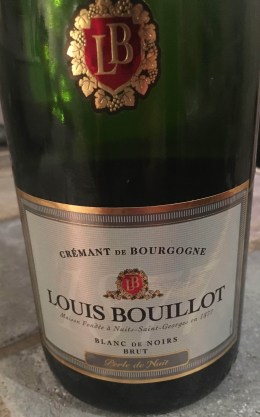 Wine: Louis Bouillot Cremant de Bourgogne Perle De Nuit Blanc de Noirs Non-Vintage Brut
- Look: Brilliant, Pale intensity, Clear – no color, small bubbles
- Smell: Clean, Medium Intensity, slight Green Apple, Almond, Toast
- Taste: Dry, High Acidity, No tannin, Medium body, Almond and some tartness like apple or cherry
- Notes: Medium Alcohol 12%, Long finish, Good quality, Ready to drink, Balanced
The second surprised me since it came from…NEW MEXICO! What? I don’t think I’ve had a New Mexican wine before, so this was a different experience. Bubbles were much larger, I thought it may have been carbonated. But now that I’ve done my research, I know that if it’s made in the Traditional Method, then it isn’t carbonated. It wasn’t bad, but it wasn’t my favorite either since the bubbles dissipate quickly; I gave it 2 stars at $16.99.
- Wine: Gruet Blanc de Noirs Non-Vintage Brut Method Champenoise
- Look: Clear, Pale intensity, Clear – no color, Large quickly dissolving Bubbles
- Smell: Clean, Low intensity, Lemon, Green Apple, Allspice
- Taste: Dry, High acidity, No tannin, Medium body, Peach, Almond
- Notes: Low alcohol 12%, Long finish, Acceptable quality, Ready to drink, Balanced
Then, because I was asked by a friend, I gathered a couple of Proseccos from Costco. Prosecco does not have the strong yeast characteristics, instead you are looking for more floral and citrus, with more sweetness. Excellent with spicy or pungent (think Blue Cheese) foods. First up was Costco’s Kirkland Prosecco from Veneto Italy (must be to be called Prosecco and have the DOCG). At $6.99 I simply don’t understand why you wouldn’t keep this on hand for every Indian or spicy Thai takeout night/spontaneous Mimosa morning/someone just came over unexpectedly and it’s happy hour, let’s open this tonight. Easily 3 stars for the value.
- Wine: Kirkland Prosecco Non Vintage Extra Dry
- Look: Clear, Pale intensity, Clear – no color, medium, quickly dissolving Bubbles
- Smell: Clean, Medium intensity, Lime, Toast
- Taste: Medium sweetness, High acidity, No tanning, Medium body, Lemon, Toast
- Notes: Low alcohol 11%, Long finish, Good quality, Ready to drink, Balanced
Last, a fan favorite – I’ve seen it many times, and so have you with it’s memorable pale blue label, Lamarca. At only $11.99 and a nice complexity, also 3 stars! While the label doesn’t state Veneto, it is a DOC and it’s a Prosecco, so that is where it is grown.
- Wine: Lamarca Prosecco Non Vintage
- Look: Clear, Pale intensity, Clear – no color, fine Bubbles
- Smell: Clean, Medium intensity, Lemon, Blossom (Hawthorn, Linden), Almond
- Taste: Medium sweetness, High acidity, No tannin, Light body, Lemon, Honeysuckle, Nutmeg
- Notes: Low alcohol 11%, Medium finish, Good quality, Ready to drink, Balanced
Cheers darlings, and a very happy New Year!
H
 CorkProf
Well done! I may be more confused than ever on the Brut/dry/sec classifications, but I’ll just laminate this and bring it with me to Total. Happy New Year! Cheers!
LikeLike