Google “GSM” and you’ll find no mention of wine on that first page of results. For a wine lover, GSM stands for the grapes Grenache (Greh-NAH-sh), Syrah (Seer-AH), and Mourvèdre (More-VED-rah) – three red beauties delicious on their own, but magical when blended together. Winemakers around the world love blends. Why? Because you can highlight the best elements of each grape variety and balance out the less desirable bits. And this trifecta is actually in my TOP 3 favorite wines to drink (along with Cab Franc and Carmenère in case you were wondering). Two things I love about GSMs are their fruitiness and spiciness which makes them fun to sip on their own and great paired with food.
The Grapes: Why is it GSM and not SMG, or MGS, or some other variation? Grenache is typically listed first because it is usually the largest percentage of the blend. Generally Syrah is next, followed by Mourvèdre. But this is variable depending on the actual wine, so a Syrah heavy blend may actually be called an SMG. There aren’t any hard rules about this, so don’t take it too seriously. I mostly use the acronym when I’m asking a server about selections, “Do you have any GSMs?” kind of thing. So, what does each grape variety bring to the party?
- Grenache, also known as Garnacha in Spain and Cannonau in Sardinia, is a perfectly lovely grape bottled by itself, producing red wines that are juicy, fresh, easy to drink, medium bodied with medium tannins and high alcohol. The primary fruit notes are strawberry, raspberry, sour cherry, and cranberry. The other key flavor is black pepper, which lends a critical spice to many blends (including Rioja in Spain which is often a blend of Tempranillo and Garnacha). It is the key grape in Châteauneuf-du-Pape and Gigondas, which are red blends in France. It can make a wonderful rosé as well!
- Syrah, as it is known in France and most of the world, and Shiraz, as it is known in Australia and South Africa, are the same grape. It’s a complex grape with many notes such as blackberry, blackcurrant, tar, leather, rosemary, black pepper, anise, lavender, dark chocolate, forest floor, and earth. Acidity is low to medium, and tannins and alcohol are high, which can allow it to age for some time. In France’s Rhône valley, it is the second or third grape in the Châteuneuf-du-Pape and Gigondas blends. Syrah is the star of the northern Rhône valley, but we’ll explore that another time. Rhône Syrah is more black peppery than Australian Shiraz. Young Australian Shiraz may be floral and lighter, becoming more herbaceous with time. In Australia, Shiraz is often blended with Cabernet Sauvignon.
- Mourvèdre, also known as Monastrell in Spain, carries “meaty” or “gamy” notes, blackberry, and herb-forward flavors with high alcohol and tannins. It’s thick skin provides excellent color. I thought these were unusual tasting notes, and honestly I’m still not clear what “meaty” or “gamy” (I also saw “animal”…ummm yikes) tastes like in a wine. There were several variations on the herb flavors: some listed fresh herbs, others dried, some said tarragon, some said thyme. Hopefully that gives you some guidance when identifying flavors in your tastings. Not many of these are bottled as single varietal, but I have had a Monastrell 85% /Syrah 15% blend called Parcelica Chica from Total Wine ($11.99) and it is on heavy rotation in our house. Very high tannins.
So what do these grapes do for each other to make the blend so lovely? For the taste, Grenache supplies the fruit and spice, Syrah also some spice and adds leather, and Mourvèdre the herb notes. All three bring high alcohol to the party, so check your labels and don’t be surprised if it’s 15%. Since Grenache is more medium body and tannin, the Syrah and definitely the Mourvèdre contribute body and tannin. Mourvèdre also adds a dose of color to the blend. The result? Delicious, fruity, spicy, full-bodied, high tannin wine!
Food Pairing Because of those high tannins, GSMs can be enjoyed with fatty foods like red meat, charcuteries, and cheeses. We’ve been experimenting pairing different kinds of chili lately, turkey chili with butternut squash, venison chili, turkey and chorizo chili…etc. And although ground turkey burgers aren’t usually fatty, if you add some good cheese (or bacon), then your pairing is made! Plus, if there’s a higher quantity of Mourvèdre, the herbaciousness pops with sage (a good turkey accompaniment). One of the best pairings will be the good old crock pot Pot Roast. I use the same wine that we are drinking (about 1.5 cups) in the crock pot to flavor the meal. You can’t beat it and your house smells amazing. A lamb curry is divine with a GSM too, again those herbs and the Mourvèdre really make it work. Finally, because of the fruitiness, I also like GSMs with tomato based dishes, like Chicken Parmesan (the cheese helps with the tannins). When considering your food pairings, look at some of the secondary notes in the wine (like spice, earth, oak) to help you decide which meal that bottle is destined to accompany. Warning! With high alcohol, spicy foods are intensified, so although I’m mentioning chili and curry up there (even if you do a pepper steak)…do watch for this interaction.
Where are they made:
- FRANCE: Frequently GSMs are found in the Southern Rhône Valley in France, most famously in Châteauneuf-du-Pape (none of these bottles are reviewed on this blog because they are … let’s just say usually (way) OVER $25 a bottle). To be fair, Châteauneuf-du-Pape wines are permitted 18 grape varieties – now there’s a blend – of which the top three are typically Grenache, Syrah, and Mourvèdre. Near Châteauneuf-du-Pape are Gigondas (think baby Châteauneuf-du-Pape = great values), Rasteau, Lirac, and Côtes du Rhône which are often based on this GSM blend and you can find some more reasonable prices.
- AUSTRALIA: Shiraz is typical in South Australia, where it is very distinctive in the Barossa Valley and there are old Grenache and Mourvèdre (aka Mataro) vines.
- SPAIN: In Priorat, Spain there are some exceptional single bottlings of Garnacha, but you will find GSM blends as well.
- CALIFORNIA: And of course, California must have its say. The Central Coast region has produced some Rhône-like wines. Wine makers called the Rhône Rangers (a play on words with the Rhône Valley and the American pioneering spirit), in the Paso Robles region produce some GSM blends.
- WASHINGTON: Washington State is on a more similar latitude as the Rhône Valley, with examples in Yakima Valley.
In my search for affordable and widely available bottles, I didn’t see much from Washington State or Southern California. Let me know if you do! Three of the four here are French (this tends to always be a theme for me). I was absolutely nuts about the Barossa (Australian) little number though, and at a stellar price, so I’ll definitely be exploring more there.
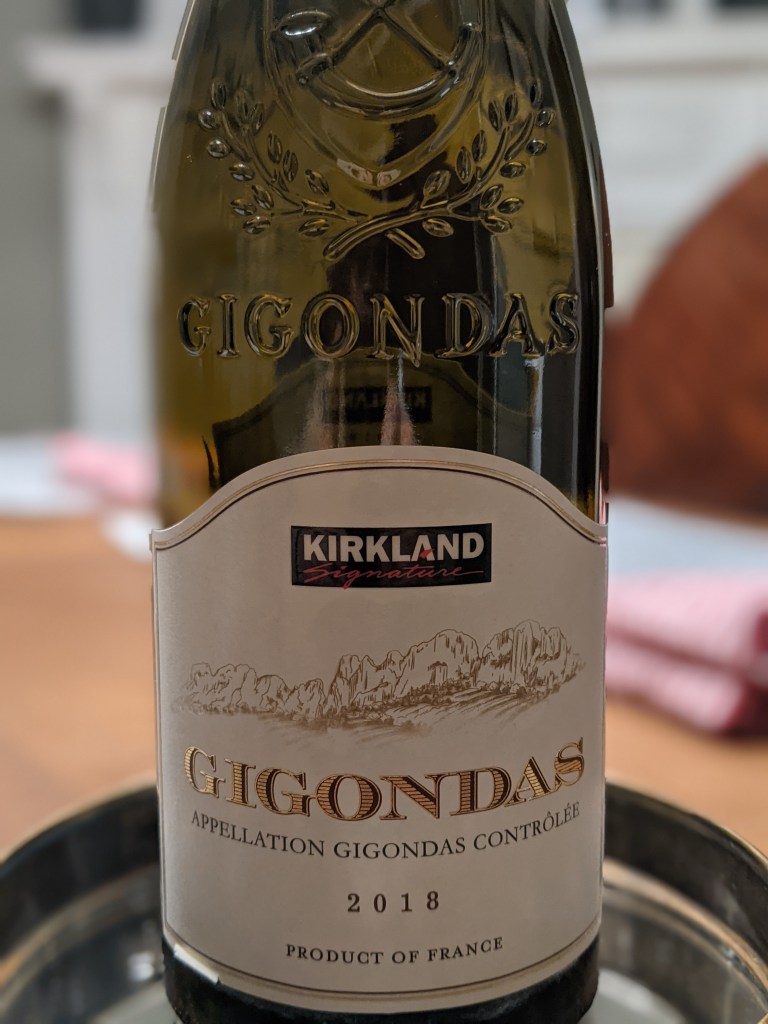
First up is a perennial favorite in our house. I buy this every time I go to Costco – Kirkland Gigondas (Jee-gone-dahce). Yes, I said it. I buy the Costco Brand Gigondas and It. Is. Delicious. I love the pepper on this when we sip it on it’s own, and it is beautiful with food. Get some. This bottle is a 2018 Gigondas (Rhône Valley, France) with a blend of 85% Grenache, 10% Syrah, and 5% Mourvèdre. Priced at $14.99 per bottle it is a tremendous value! I give it 4 stars. Alcohol is 15%.
- Look: Clear, Deep Color, Garnet
- Smell: Clean, Medium Intensity Color, Strawberry, Violet, Tobacco, Clove
- Taste: Dry, High Tannin, Medium Acid, Medium Body, Sour cherry, Strawberry, Cranberry, Tar, Black Pepper, Toast
- Notes: Medium alcohol, Long Finish, Excellent, Ready but could age, Balanced
Next is another Rhône area wine, the Famille Perrin Côtes du Rhône Reserve from Total Wine for $9.99. I’ve had other Famille Perrin wines that I’ve enjoyed more. This is a 2018; it does not list the percentage of each grape on the bottle. 14.1% alcohol. 2 stars. Not a bad wine for the price, just not remarkable.
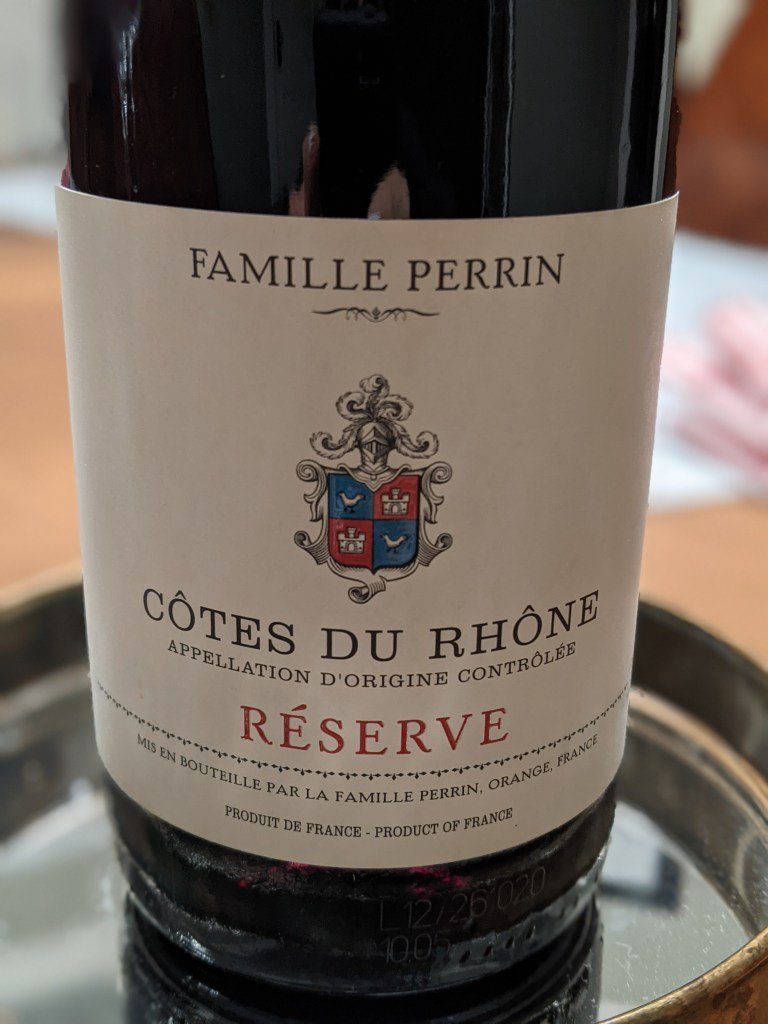
- Look: Clear, Deep Color, Purple
- Smell: Unclean*, Medium intensity Color, Strawberry, Cherry, Mint
- Taste: Dry, High Acid, Medium Tannin, Full Body, Sour Cherry, Cranberry, Bell Pepper, Toast
- Notes: High Alcohol, Medium Finish, Acceptable, Ready to drink, Unbalanced
- *What is “unclean?” There are all kinds of flaws that can be named in wines, from smelling like horses or sweat, to moldy basements, to acetone nail polish remover. I’m not a certified flaw taster, but I do believe that, like you, I can note when something is a little off when I smell it, although I can’t always put my finger on what that something is. My version of “unclean” is when something isn’t quite right.
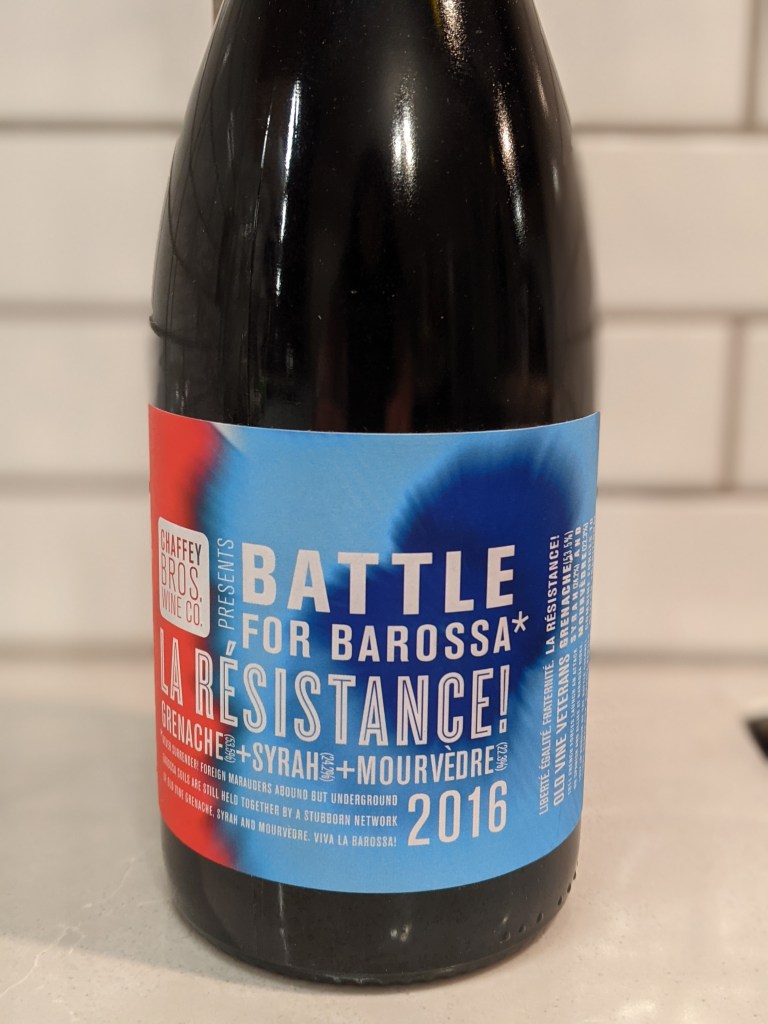
Last was a very tasty Barossa Valley, Australia GSM with 53% Grenache, 24% Syrah, and 22% Mourvèdre. From Chaffey Bros Wine Co, the Battle for Barossa La Résistance! (what a great name for a wine, I was excited before I even opened it). Alcohol is 14.5%. I was looking for an SGM, but didn’t see anything in the price range. At $10.99 this baby gets 4 stars! We have it on our regular rotation now.
- Look: Clear, Medium Intensity Color, Mahogany
- Smell: Clean, Medium Intensity, Strawberry, Earth
- Taste: Dry, High Acid, Medium Tannin, Medium Body, Sour cherry, Strawberry, Raspberry, Cherry, Forest, Black Pepper, Vanilla, Toast,
- Notes: Medium Alcohol, Long Finish, Good, Ready to Drink, Balanced
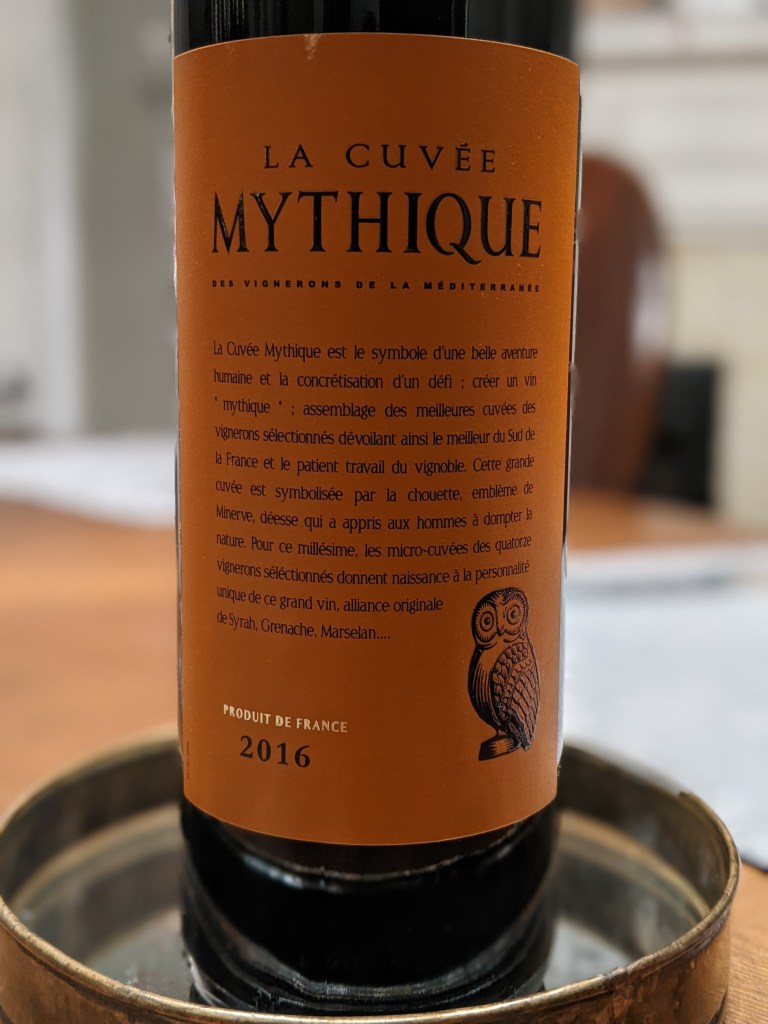
Bonus Wine: This one is not a true GSM, but a blend from the Languedoc region of France. Alcohol is 13.5%. At $14.99 from Total Wine, the La Cuvée Mythique is 31% Marselan, 29% Syrah, 17% Carignan, 14% Grenache, and 9% Mourvèdre. I gave it 3 stars – although it has complex flavors, it had a short finish, and I prefer a fuller bodied wine. From what we know about Syrah, I was expecting more spice and tannin, which makes me think I need to learn more about Marselan and Carignan since that makes up 45% of the bottle.
- Look: Clear, Medium Intensity Color, Garnet
- Smell: Clean, Medium Intensity, Raspberry, Forest
- Taste: Dry, Medium Acid, Low Tannin, Medium Body, Sour Cherry, Strawberry, Raspberry, Blackberry, Clove, Vanilla
- Notes: Medium Alcohol, Short finish, Good, Ready to drink, Balanced
Cheers,
H
 CorkProf